Introduction
Modern missiles face extreme thermal conditions. High-power electronic devices are packed into very small spaces. Local heat flux can reach tens or even hundreds of watts per square centimeter. Traditional solid conduction and natural convection are no longer enough to cool these systems effectively.
A vapor chamber is a flat heat pipe that uses phase change to spread heat across a surface. It has extremely high effective thermal conductivity, excellent temperature uniformity, a compact form factor, and no moving parts. These qualities make it ideal for missile platforms where space is tight and reliability is critical.
Vapor chambers are now used in many missile subsystems, including infrared seekers, active radar seekers, onboard computers, power supplies, laser components, and airframe thermal protection. This article explains the main application scenarios, technical advantages, key design requirements, and typical integration methods for vapor chambers in missiles.
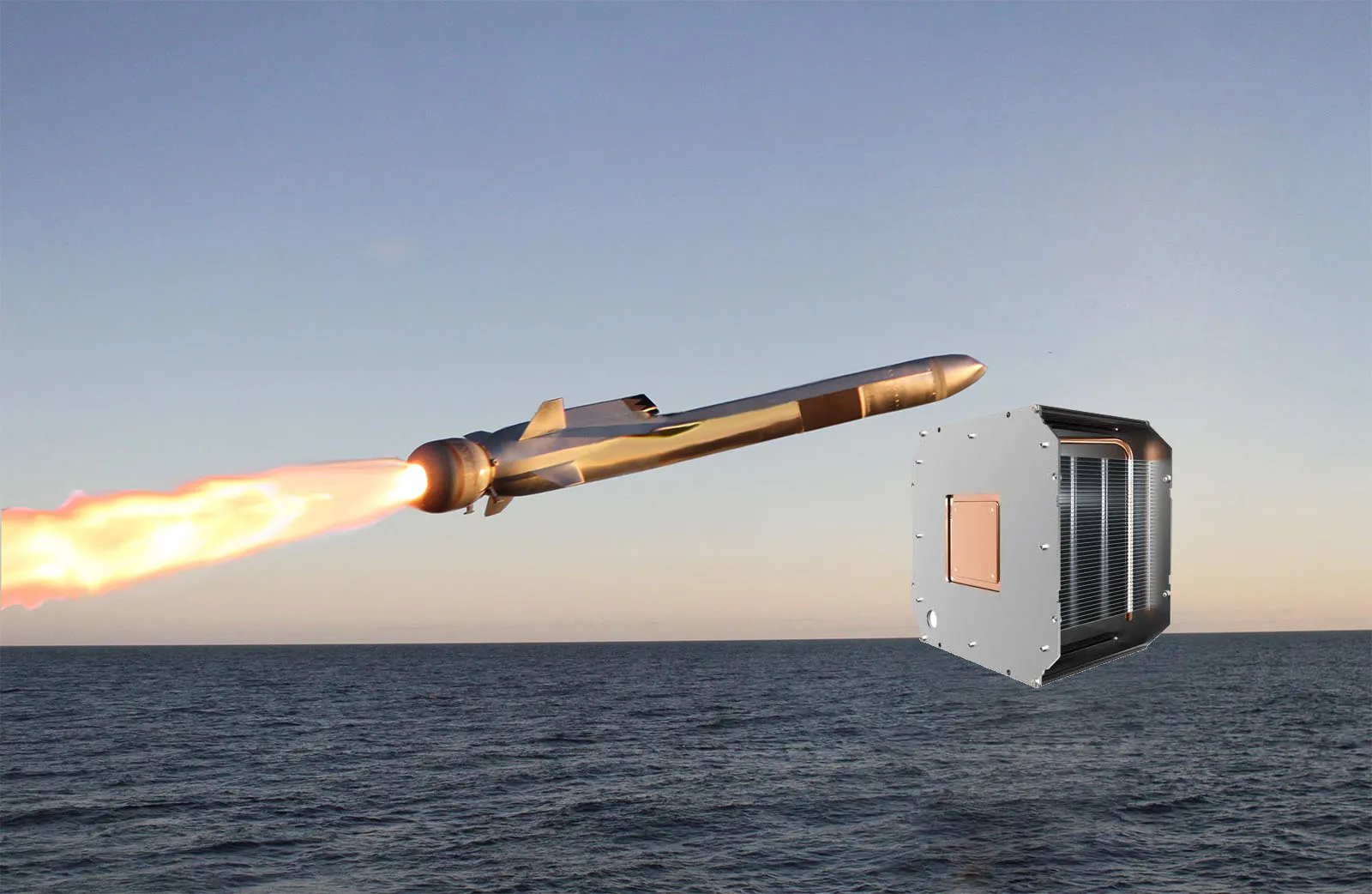
Why Missile Thermal Management Is Challenging
Missile thermal design must overcome several unique difficulties:
1. Very high heat flux
Phased array radar T/R modules, laser diodes, and power chips generate intense heat in small areas. Standard cooling methods cannot remove heat fast enough.
2. Extremely limited space
Missiles have very compact internal layouts. There is little room for large heatsinks, fans, or liquid cooling loops.
3. High g-forces and strong vibration
During launch, missiles experience axial acceleration of several tens of g. In flight, wideband random vibration is present. Thermal hardware must be mechanically strong and fatigue-resistant.
4. Wide temperature range and aerodynamic heating
Missiles may be stored in hot ground environments, then fly through cold upper atmosphere. High-speed flight also causes aerodynamic heating on the outer skin.
5. Long storage life with one-time use
Missiles are stored for years but operate for only a short time. Thermal devices must remain sealed and reliable during storage, then work perfectly for a brief mission.
Vapor chambers address many of these challenges through their phase-change mechanism and robust structural design.
Key Application Areas for Vapor Chambers in Missiles
Infrared Seekers and Optical Detectors
Infrared focal plane arrays (IRFPA), dewar assemblies, and optical detectors must operate at low or constant temperatures to maintain sensitivity and image uniformity. The detector chip is small, but heat is concentrated.
A vapor chamber spreads heat from the focal plane chip quickly and evenly to the cryocooler cold head or heat sink. This reduces surface temperature gradients, prevents hot spots that cause noise or pixel failure, and improves imaging quality and detection range.
Active Radar Seekers and T/R Modules
Active phased array radar seekers contain many tightly packed T/R modules behind the antenna. Heat density is very high.
Vapor chambers can be placed between T/R modules and the missile cold plate, under power amplifier modules, or inside the array backplane. They flatten the temperature distribution across the array, preventing local overheating. This allows higher transmit power, longer component life, and better beam pointing accuracy.
Onboard Computers and High-Performance Processors
Missile computers, image processing boards, FPGAs, DSPs, and GPUs produce concentrated heat in very small enclosures. Fans and complex liquid cooling are not practical.
A vapor chamber mounted between the chip and the housing spreads the hot spot across the entire module baseplate. This lowers contact resistance and spreading resistance. Without forced airflow, a vapor chamber can keep junction temperatures within safe limits during a short mission.
Power Supplies and Power Conversion Modules
Secondary power supplies, DC/DC converters, and servo power amplifiers contain power transistors, rectifiers, and magnetics that generate significant heat.
Vapor chambers spread this heat evenly to the chassis or cold plate, avoiding localized overheating that reduces efficiency, damages insulation, or causes device failure. Under pulsed loads or short high-power bursts, vapor chambers combined with phase change materials provide extra thermal buffering.
Laser Seekers and Laser Designators
Laser diodes and solid-state laser pump sources are highly temperature-sensitive. Temperature shifts directly affect output wavelength and power stability.
A vapor chamber quickly removes heat from the laser hot zone, reduces temperature fluctuations, and stabilizes laser output. This improves designation accuracy and overall seeker reliability.
Airframe Thermal Spreading and Aerothermal Management
Hypersonic and high-speed missiles experience severe aerodynamic heating on external surfaces. Local hot spots can cause high thermal stress or overheat internal equipment.
Vapor chambers can be embedded behind the missile skin, equipment mounting plates, or thermal protection layers. They spread localized high temperatures over a larger area, reducing temperature gradients and thermal stress while protecting internal electronics and structure.
Technical Advantages of Vapor Chambers in Missiles
Vapor chambers offer several important benefits for missile thermal management:
1. High heat transfer capabilityEffective thermal conductivity ranges from several thousand to tens of thousands of W/(m·K), far exceeding copper or aluminum.
2. Excellent temperature uniformityThey turn a point heat source into a surface heat source, dramatically reducing temperature differences.
3. Compact and shape-flexibleVapor chambers can be made flat, curved, or irregularly shaped to fit tight missile compartments.
4. No moving parts, high reliabilityThey rely on phase change and capillary force, not mechanical pumps. This makes them suitable for short-duration, high-g missions.
5. Easy integration with other thermal solutionsVapor chambers can be combined with cold plates, heat pipes, phase change materials, and microchannel liquid cooling to build multi-layer thermal management systems.
Key Design and Reliability Requirements
Missile environments place strict demands on vapor chamber design and manufacturing.
Resistance to High g-Forces and Vibration
The internal wick structure and casing must survive launch and flight loads. Designers often use sintered metal powder wicks with high porosity, internal ribs or support posts, and strong welding processes to prevent wick collapse or weld cracking.
Working Fluid and Material Compatibility
The working fluid must remain chemically compatible with the casing and wick over long periods. Any non-condensable gas generation will degrade performance. Common fluids include deionized water, acetone, and ammonia. Casing materials may be copper, aluminum, titanium, or stainless steel. For missile use, lightweight aluminum and titanium vapor chambers are preferred.
Wide Operating Temperature Range
Vapor chambers must work reliably across storage and flight temperature extremes. Different fluids suit different ranges:
- Water: roughly 5°C to 150°C
- Acetone: medium temperature range
- Ammonia: low temperature range
The choice depends on the specific thermal environment of each missile subsystem.
Sealing and Long-Term Storage
Missiles are stored for many years. Vapor chambers must have extremely low leak rates to prevent fluid loss or performance degradation. Laser welding, electron beam welding, and brazing are common sealing methods, followed by helium mass spectrometer leak testing.
Lightweight Design
Missiles are weight-sensitive. Vapor chambers should be as thin and light as possible while maintaining performance. Aluminum-based vapor chambers, thin walls, and lightweight wick structures help meet strict mass limits.
Typical Form Factors and Integration Methods
Depending on internal space and heat source distribution, vapor chambers in missiles take several forms:
-
Flat plate vapor chambers
Mounted directly under chips or T/R modules to spread heat from hot spots.
-
Curved or conformal vapor chambers
Shaped to match seeker housings or missile skin curves for conformal cooling.
-
Embedded vapor chambers
Built into cold plates or structural parts, creating multifunctional structures.
-
Vapor chamber plus phase change material
Used for short high-power pulses, such as terminal guidance phase. The vapor chamber spreads heat quickly while the PCM absorbs peak energy.
-
Vapor chamber plus heat pipes or liquid cooling
Transfers heat from the vapor chamber to an external skin heat sink or internal liquid loop for longer-distance heat transport.
These integration methods can be combined flexibly to build efficient and reliable thermal management systems for different missile sections and equipment.
Future Trends and Conclusion
As missiles become more electronic and intelligent, power densities will keep rising. Thermal management requirements will become even more demanding. Vapor chambers will continue to evolve toward thinner, lighter, higher-performance designs with better environmental tolerance. They will also integrate more closely with microchannel liquid cooling, phase change energy storage, high-conductivity composites, and intelligent thermal control.
The core role of vapor chambers in missiles is to solve local hot spot problems and enable efficient heat spreading in very compact spaces. Their high conductivity, uniform temperature distribution, small size, and lack of moving parts make them a fundamental component of missile thermal management. As materials, manufacturing processes, and system integration advance, vapor chambers will play an even more important role in next-generation missile systems.