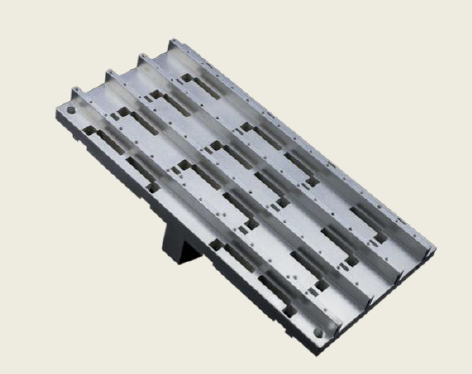
Liquid Cooling Cold Plates
High-Performance Micro-Channel Thermal Management Solutions
- Heat transfer coefficient: Exceeds 105 W/m²·K
- Cooling capacity: Up to 300 W/cm² heat flux
- Welding process: Flux-free high-frequency diffusion welding
- Bond strength: Over 90% of base material strength
- Materials: Aluminum alloy, titanium alloy, stainless steel
- Customization: Arbitrarily complex flow channel geometrie
Product Overview
Our liquid cooling cold plates are engineered for high-heat-flux electronic devices that demand reliable and efficient thermal management. Utilizing an innovative flux-free high-frequency diffusion welding process, these cold plates achieve seamless integration between components with bond strength exceeding 90% of the base material's strength.
The micro-channel design enables heat transfer performance exceeding 105 kW/m²·K (105,000 W/m²·K), effectively meeting cooling requirements for devices generating up to 300 W/cm². Internal flow channels can undergo anti-corrosion surface treatment, ensuring superior corrosion resistance and extended service life in demanding environments.
Key Features
Excellent Heat Transfer Performance
Capable of producing cold plate structures with arbitrarily complex designs and micro-channels; heat transfer performance exceeds 105 kW/m²·K, meeting cooling requirements for devices generating 300 W/cm².
Strong Corrosion Resistance
Utilizes a flux-free high-frequency diffusion welding process, ensuring seamless connections between components; internal flow channels can undergo anti-corrosion surface treatment, resulting in superior corrosion resistance.
High Structural Strength
High-frequency diffusion welding achieves bond strength exceeding 90% of the base material's strength; post-weld strengthening treatments ensure excellent pressure resistance and overall structural rigidity.
Customizable Specifications
Customizable liquid-cooled cold plates available in various specifications. Innovative welding and forming process ensures seamless integration and high bond strength; supports arbitrarily complex flow channel geometries and offers robust corrosion resistance.
Technical Specifications
Technical specifications of G2 Defense liquid cooling cold plates| Minimum Product Thickness | 3 mm |
|---|---|
| Maximum Heat Flux Density | 300 W/cm² (3,000,000 W/m²) |
| Maximum Pressure Resistance | >2.0 MPa (aluminum alloy) |
| Maximum Dimensions (L × W × T) | 1,200 mm × 1,000 mm × 11 mm |
| Surface Flatness | <0.2 mm per 100 mm × 100 mm area |
| Available Materials | Aluminum alloy, titanium alloy, stainless steel |
| Pressure Drop | Determined based on specific flow rate of working fluid |
| Heat Transfer Coefficient | >105 kW/m²·K (>105,000 W/m²·K) |
| Cooling Capacity | Up to 300 W/cm² |
Applications
- IGBT Module Cooling — Power electronics, rail transport, renewable energy systems
- Semiconductor Laser Cooling — Industrial lasers, medical devices, defense systems
- CPU/GPU Cooling — Data centers, high-performance computing, AI servers
- Power Electronics — Inverters, converters, motor drives
- Aerospace & Defense — Avionics, radar systems, electronic warfare equipment
- Electric Vehicles — Battery thermal management, motor controllers
Frequently Asked Questions
What is the maximum heat flux a liquid cooling cold plate can handle?
Our micro-channel liquid cooling cold plates handle heat flux up to 300 W/cm² (3,000,000 W/m²), making them suitable for high-power IGBT modules, semiconductor lasers, and data center CPUs and GPUs.
What materials are available for custom cold plates?
We offer aluminum alloy, titanium alloy, and stainless steel cold plates. Material selection depends on thermal performance, weight, and corrosion resistance requirements.
What welding process is used for your cold plates?
We use flux-free high-frequency diffusion welding, which achieves bond strength exceeding 90% of the base material strength and ensures seamless, leak-free internal flow channels.
What is the minimum thickness and maximum size of a custom cold plate?
The minimum product thickness is 3 mm, and the maximum dimensions are 1,200 mm × 1,000 mm × 11 mm (L × W × T). Surface flatness is better than 0.2 mm per 100 mm × 100 mm area.
What pressure can your liquid cold plates withstand?
Aluminum alloy cold plates withstand more than 2.0 MPa burst pressure. Post-weld strengthening treatments ensure excellent pressure resistance and overall structural rigidity.
Customization
We offer fully customizable liquid-cooled cold plates in various specifications to meet your specific thermal management requirements. Our engineering team supports arbitrarily complex flow channel geometries and works with aluminum alloy, titanium alloy, and stainless steel materials. Contact us today to discuss your custom cold plate project.