Why Intercoolers Matter on Naval Gas Turbines
Intercooled-recuperated (ICR) gas turbines have long been favored for marine propulsion because they deliver better thermal efficiency at low load, higher power density, and lower noise and infrared signatures than simple-cycle designs. The intercooler sits between the low-pressure and high-pressure compressors, cooling the compressed air so the high-pressure compressor draws less work.
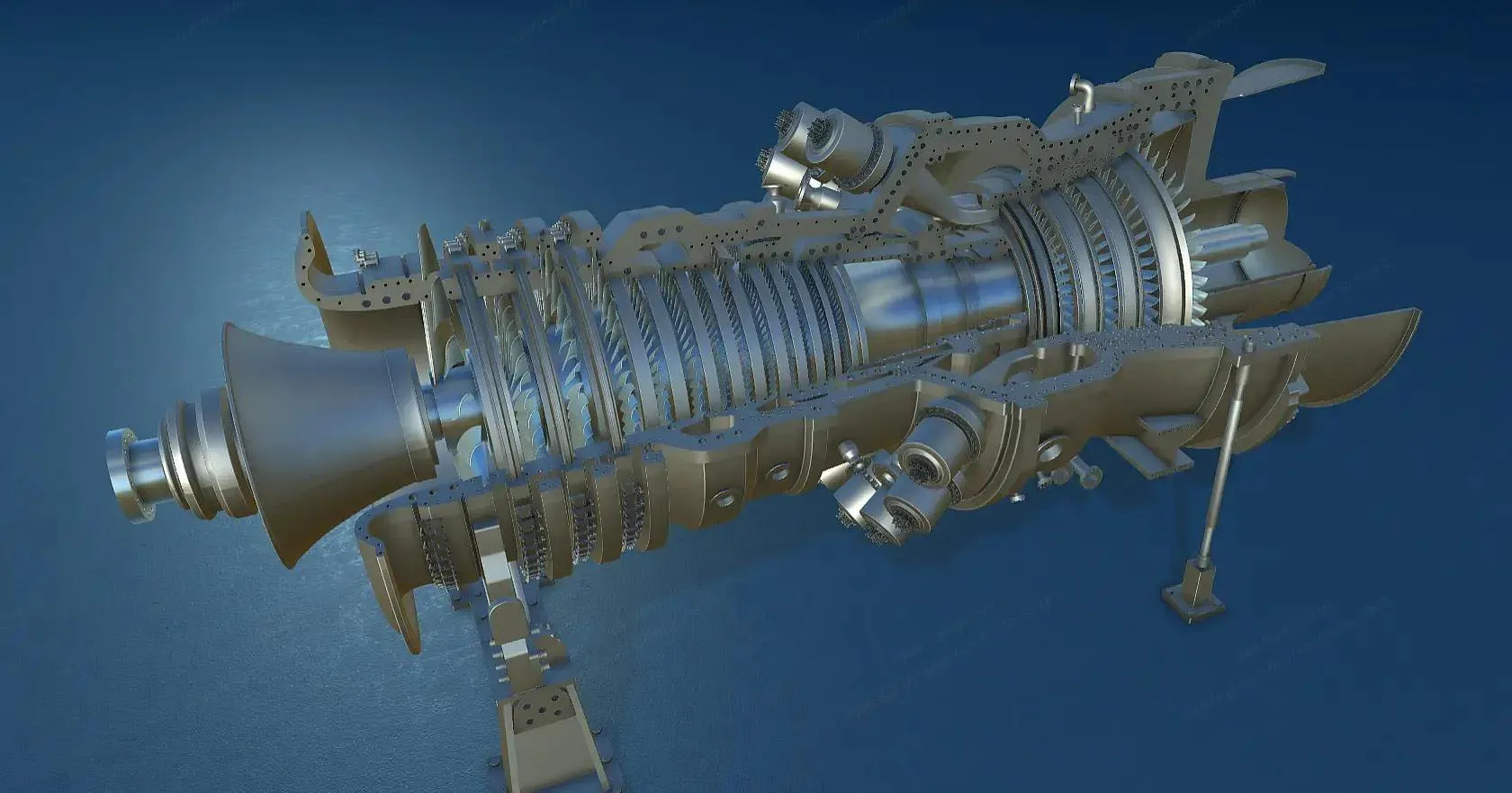
The catch is real estate. On a warship, the intercooler has to fit inside a narrow annular duct. That pushes designers toward compact heat exchangers — and PCHE is one of the densest options available, with surface-area-to-volume ratios reaching 2,500 m²/m³.
"PCHE was already the right technology for this application," said Cheng Keyong, senior engineer and corresponding author. "The question was whether we could systematically tune dozens of geometric parameters at once instead of relying on trial and error. The genetic algorithm lets us do that."
What the Team Optimized
The researchers modeled a ten-segment annular intercooler arranged around the gas turbine shaft — a layout borrowed from the WR-21 engine. Hot compressed air (72.93 kg/s, 155°C inlet) crosses a 50% ethylene glycol-water coolant loop (200 kg/s, 20°C inlet) in a single-pass cross-flow arrangement through straight rectangular microchannels.
Nine structural parameters were allowed to vary within manufacturing-feasible ranges:
- Fin pitch and fin thickness on both hot and cold sides
- Printed circuit board spacing and number of layers
- Channel count per plate
- Base plate thickness, cover plate thickness, and side rib thickness
The MATLAB-based genetic algorithm used a population of 50, a crossover probability of 0.8, and an adaptive mutation operator that respects boundary and constraint conditions automatically.
The Three Optimization Outcomes
Running the optimizer separately for each objective produced three distinct designs — and exposed the trade-offs naval engineers have to weigh.
Minimum pressure drop. Total pressure drop fell from 5,015 Pa to 927 Pa. The cold side did most of the heavy lifting: because ethylene glycol is roughly 40 times more viscous than air, widening cold-side channels and increasing plate spacing cut cold-side pressure loss by 83.17%. The price was a 96.7% larger volume and a 21.5% drop in compactness.
Lightest mass. Total mass dropped from 978 kg to 219 kg, driven mainly by fewer plate layers, narrower cold-side fin pitch, and smaller plate spacing. Volume shrank by 74%. But the smaller channels pushed pressure drop up by 244.6%, meaning higher pumping power.
Highest compactness. Surface-area density climbed from 1,185 to 2,004 m²/m³. Both heat transfer area and volume decreased, but volume fell faster. Pressure drop rose by 320.4%.
None of the three is a free lunch. Lower pressure drop costs space; lighter weight and higher compactness cost pumping power. The right pick depends on whether the vessel's design constraint is duct volume, weight budget, or auxiliary power.
Variable Mass Flow: A Second Look
The team also held heat duty constant while sweeping hot-side mass flow from 60 to 85 kg/s. Across all three objectives, the pattern was consistent: higher mass flow reduced total pressure drop and mass but raised compactness. Effectiveness (ε) and number of transfer units (NTU) both declined as mass flow rose — by roughly 25–28% for effectiveness and 47–52% for NTU across the range.
For designers, that means running a higher hot-side mass flow can shrink and lighten the intercooler, but only at the cost of heat exchanger effectiveness.
What This Means for the Marine Sector
For shipyards and naval architects specifying ICR gas turbines, the study provides a validated, reproducible method to size PCHE intercoolers against the actual constraints of a given hull. Rather than choosing from a handful of off-the-shelf geometries, engineers can now push a multi-parameter optimization toward whichever metric matters most for the platform.
The copper-nickel alloy construction and straight-channel design also keep manufacturing within established PCHE fabrication capabilities — no exotic materials or unproven channel shapes required.
As navies and commercial operators continue to press for higher efficiency and lower emissions from gas turbine propulsion, optimization-driven compact heat exchanger design is likely to become standard practice rather than a research novelty.
The full paper, "Optimization Design of Intercooler for Marine Gas Turbine" by Yang Jian, Chen Junlin, Cheng Keyong, and Huai Xiulan, is available in the Journal of Engineering Thermophysics, December 2024.
Need a custom PCHE intercooler for your marine gas turbine?
G2 Defense Technology specializes in military-grade thermal management and compact heat exchangers. Contact us to discuss your project requirements.
Contact Us Learn More About PCHE